

Overthinking is Keeping You Stuck. Experimenting is the Way Out.
The benefits of plus/minus/next journaling

Welcome to Humans Leading, a space designed just for you by me, Dr. Jillian. As a busy physician, toddler mom, certified stress management coach, and wellness trainer who has experienced and recovered from burnout, I know what it’s like to feel overwhelmed and stuck. Via the Humans Leading publication and community, you’ll learn ways to live a less stressed, more satisfying life without completely overhauling your life. Subscribe here to get future posts straight to your inbox:
✨ Last time: Vision boarding with Janet Tanguay Listen here.
✨ Today: How to get out of analysis paralysis

A few weeks ago, I was on a zoom call with a group of entrepreneurs chatting about how to sell things once you’ve made them. (Thanks Seth Werkheiser!)
As we chatted, one of the people in the group was discussing being unsure of how to sell their product now that they’d made it.
They explained that they saw multiple ways that they could potentially sell it but weren’t sure which one was the right way. And they were bringing this question to the group in order for people to share their expertise and experience.
As I listened, I could hear how much this person was agonizing over which way would be the “right” way to go.
Is it path A? Or maybe it’s B? Or it’s A and B?
Or maybe it’s path C that they haven’t considered yet? Did anyone know?
Obviously, I’m no expert in selling or marketing. But, as a coach, I couldn’t stop myself from offering an observation about what was happening for that person:
Analysis paralysis
In other words, overthinking that has gotten so bad that it keeps you stuck in endless research, asking questions of others, and stress.
This is such a common experience when faced with uncertainty.
I imagine that all of us have been there at one point or another.
We seek out certainty before acting because we believe that it will keep us from failing. Unfortunately, all this approach does for us is keep us from taking the action that will help us get to where we want to go. And then we beat ourselves up for not taking action.
Over time, this becomes a vicious cycle.
But it doesn’t have to be like this.
Instead, we can lower the bar on taking (imperfect) action through designing tiny experiments and using plus/minus/next journaling.
What are tiny experiments?
To understand tiny experiments, we have to dig a little bit deeper into how the brain learns.
Your brain doesn’t learn by you agonizing over every detail of a decision and then eventually having enough details to execute that thing perfectly. As we already established, agonizing is what keeps you stuck and, as a consequence, what keeps you from learning.
The thing that allows you to learn and grow is what neuroscientist, author, and founder of Ness Labs Anne-Laure Le Cunff calls “growth loops” of trial and error in which we try something, analyze what did or didn’t work, and make adjustments.
This process can be made simpler through setting up “tiny experiments” in which you:
choose a small action that you will take
for the person in the story above, this would be committing to one of the methods of selling rather than being stuck in agonizing over which one is the “right” one
pick a length of time in which you will implement it
the length of time is up to you, but don’t make the time period so short that you won’t be able to see results or so long that you feel like you’ll be struggling to commit to it
do the thing
in this process, barriers to doing the thing are also helpful information when it comes time to evaluate. So don’t beat yourself up about it if you’re having a hard time getting started
evaluate how it went at the end of the experimental period using plus/minus/next journaling
What’s plus/minus/next journaling?
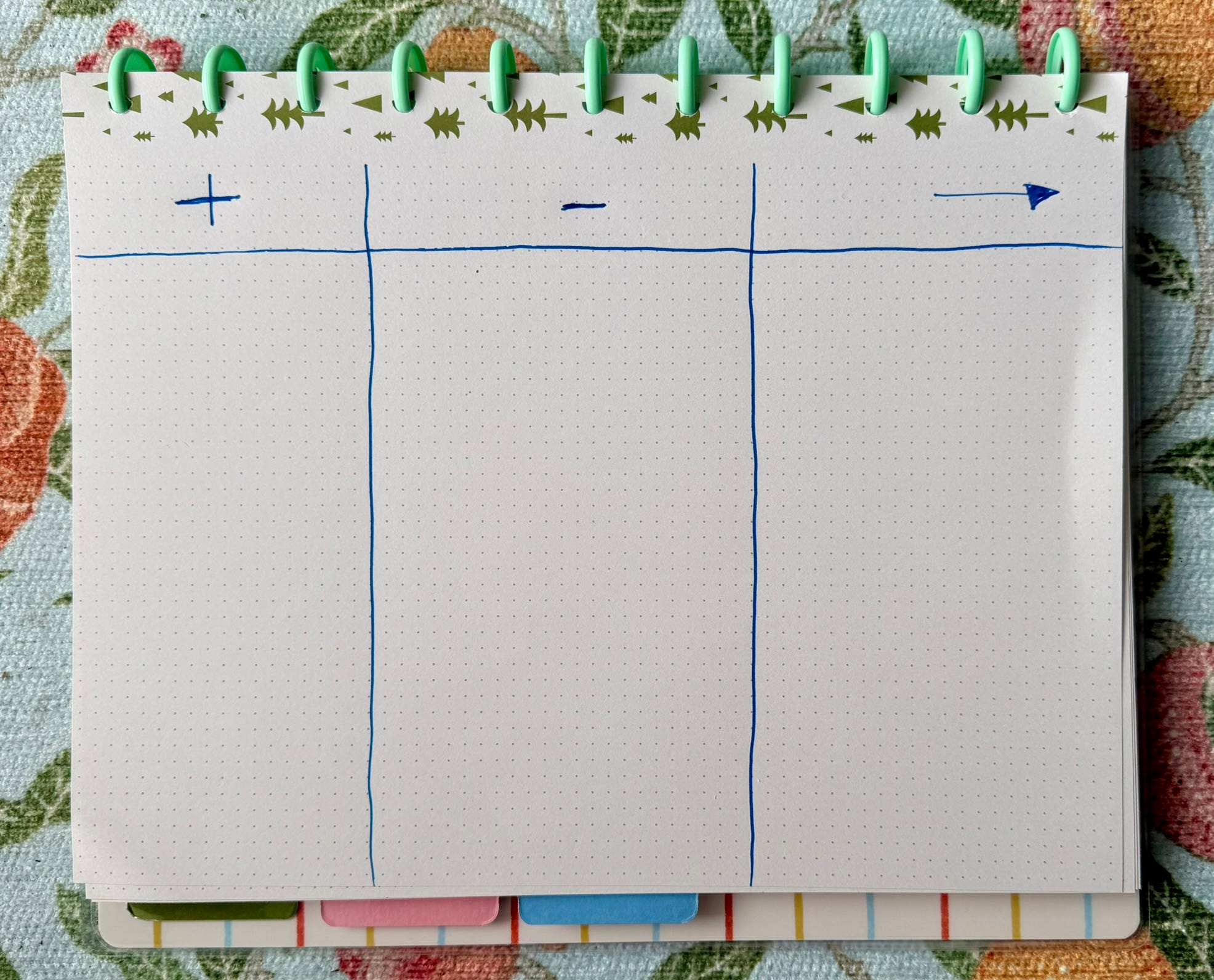
If you look at the image above, you can see that this process is exactly how it sounds. On a sheet of paper (or a blank document on your computer), draw three columns. At the top, label them Plus (+), Minus (–), Next (→).
More details on the process:
At the end of your tiny experiment, sit down and journal your plus/minus/next:
Plus (+): Write down what went well, what made you happy, what was helpful, or what you achieved/completed during the experimental period.
Minus (–): Write down what did not go well, tasks you avoided, or areas of friction (barriers to getting started, what was unhelpful, etc.).
As I said above, those barriers are just as important (if not more important) than what went well. They are the key to helping you set up something that works better for you next time.
Next (→): List your practical steps, adjustments, or experiments for the upcoming time period.
You might also find that you don’t want to iterate on this experiment anymore because it wasn’t helpful to you or you’ve decided to move on from whatever you were doing. That is also valid. Set up a new tiny experiment for whatever you want to be doing, and get back to taking action.
How it helps:
Low time-commitment = low friction: This process only takes a few minutes, so it’s easy to turn into a regular habit.
Data-driven: Being objective about what worked and what didn’t treats setbacks as neutral data points rather than as personal failures. That way you don’t get stuck wasting time and energy beating yourself up about something that is just part of the growth process.
Focused on action to get you unstuck: This process focuses on forward momentum instead of being stuck in analysis paralysis, self-doubt, or self-criticism.
I highly recommend trying this process out if you’ve been stuck in analysis paralysis recently. You can also read more about it over on the Ness Labs webpage.
And, if you’re looking for a great read or listen on audiobook, I highly recommend checking out the book “Tiny Experiments.”

What tiny experiment would help you get started on something this week?
I’d love for you to share in the comments so that I can cheer you on. And if you’re looking for some support to begin to make adjustments in your own life, I will have some 1:1 and group coaching offerings opening up soon. You can get all of the details by subscribing to Humans Leading. See you next time!
xJillian
Looking for more resources?
Over 100 posts to help you get started on transforming your life: Humans Leading Archive
1:1 stress management and life design coaching: to help you overcome burnout and start living a life you love.
Stress management workshops: to help you learn to weave helpful practices throughout your day
Dip into the Humans Leading podcast archive for inspiring interviews and mini-episodes.